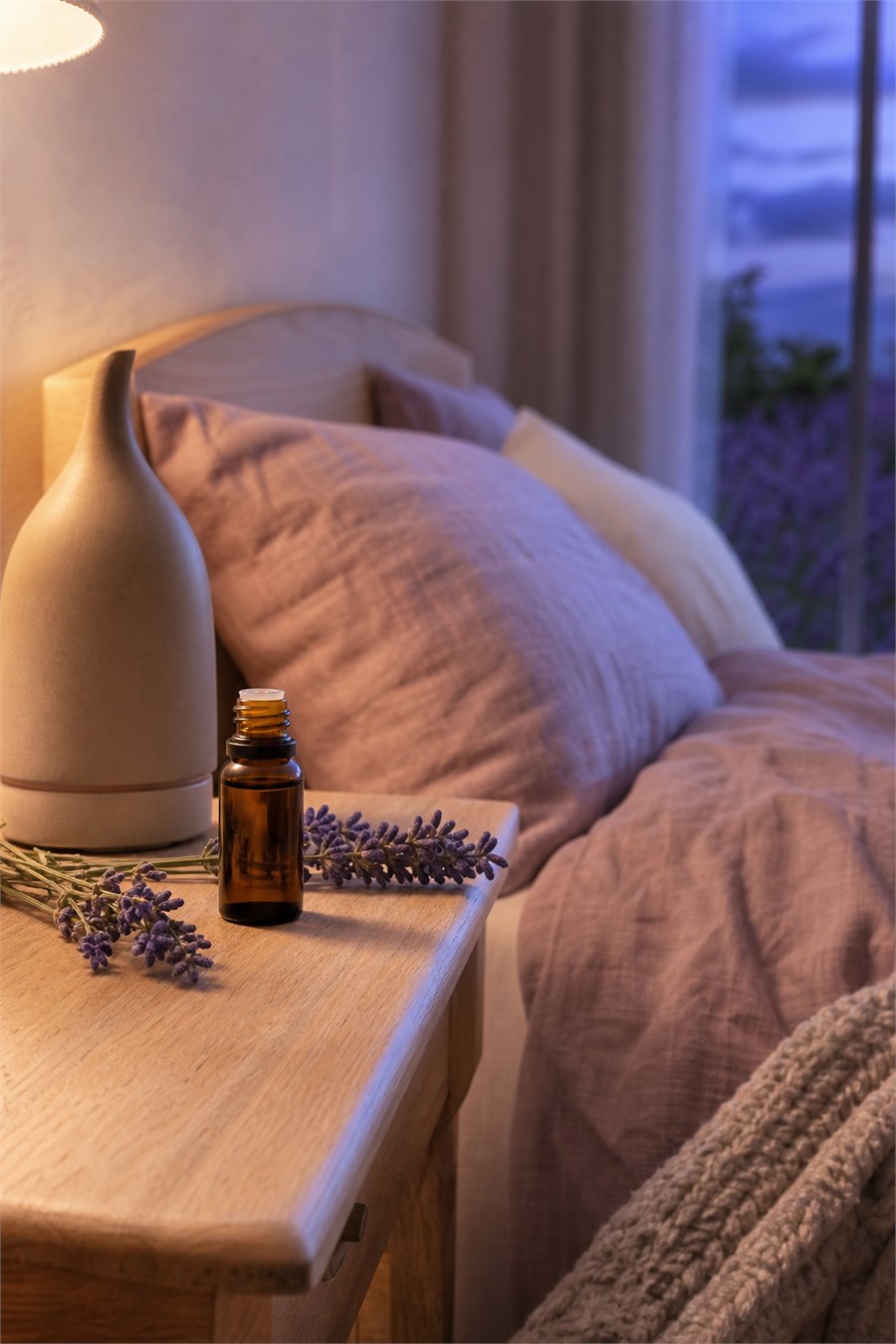
10 practical benefits, without exaggerated promises.
True Lavender has a softer floral-herbal profile suited to evening and diluted body-care rituals. Lavandin is brighter and more camphoraceous, making it useful for daytime and fresh-home blends. The cards below give a clear “why it fits” and an exact “how to use” for each search intent.
Creates a consistent wind-down cue
Lavender aroma can become part of the transition from screens and deadlines to a quieter evening.
Why it fits: Some aromatherapy studies report improved sleep quality, but larger rigorous trials are still needed. The repeatable routine may matter as much as the scent.
How to use: Add 3 drops True Lavender to a 100 mL diffuser for 30 minutes while preparing for bed; switch it off before sleep.
Open the sleep guide →Marks a sensory pause during a busy day
A familiar aroma can help define a brief moment for slow breathing, journaling or stepping away from work.
Why it fits: Evidence for inhaled lavender and stress or anxiety is encouraging in some studies but remains too inconsistent for a treatment claim.
How to use: Put 1–2 drops on the wick of a personal aroma inhaler and take one or two gentle inhalations during a break.
See inhalation amounts →Adds botanical fragrance to body care
Properly diluted True Lavender can scent a simple jojoba body oil without synthetic perfume.
Why it fits: This is a cosmetic sensory use. Lavender is not a treatment for eczema, acne, sunburn or irritated skin, and topical products can cause allergic reactions.
How to use: Mix 2 drops in 10 mL jojoba oil (about 1%). Patch-test for 24 hours and use only on intact skin.
Open the skin guide →Turns scalp care into an aromatic ritual
A wash-out carrier-oil treatment can add soft herbal fragrance and a slower self-care moment.
Why it fits: Evidence does not establish lavender oil as a hair-growth or scalp-disease treatment. The clear value here is aroma and massage experience.
How to use: Add 3 drops to 15 mL coconut, jojoba or argan oil. Massage gently, leave 20 minutes, then shampoo out.
Open the hair guide →Complements a head-and-neck comfort ritual
Low-dilution aroma plus gentle touch can make a tense moment feel more intentional.
Why it fits: FDA treats claims to relieve pain or relax muscles as drug claims. Persistent, sudden or severe headaches need medical evaluation.
How to use: Mix 1 drop with 5 mL carrier oil. Massage shoulders or the back of the neck, avoiding eyes and temples if you are sensitive.
See topical safety →Freshens the atmosphere for focused work
Brighter Lavandin pairs with citrus to make an afternoon workspace smell crisp rather than sleepy.
Why it fits: Aroma can shape how a room feels, but “improves concentration” is not an established medical effect.
How to use: Diffuse 2 drops Lavandin + 2 drops Bergamot + 1 drop Lemon in 100–150 mL water for 30 minutes.
Get the focus blend →Gives routine cleaning a fresh botanical finish
Lavandin’s herbal-camphor profile reads as bright and clean in kitchen and entryway scent blends.
Why it fits: Fragrance is not disinfection. Use an appropriate registered product when sanitizing or killing germs matters.
How to use: Add 8 drops Lavandin to 120 mL of a prepared room-spray base. Shake and spot-test surfaces or fabrics.
See the fresh-home formulas →Adds lavender aroma to outdoor evenings
Lavandin can be enjoyed as a personal or patio scent, but scent and verified insect protection are different goals.
Why it fits: EPA notes that products without an EPA registration number have not been evaluated by the agency for effectiveness.
How to use: Diffuse only according to the device label. For mosquito or tick protection, choose an EPA-evaluated repellent and follow its label.
Read EPA guidance →Supports a more pet-aware home routine
The benefit is knowing how to reduce exposure—not putting lavender oil on a dog or cat.
Why it fits: Concentrated essential oils can be dangerous to pets. Direct application and ingestion should be avoided.
How to use: If your veterinarian agrees, diffuse briefly in a ventilated room the pet can leave. Keep the diffuser and bottles out of reach.
Open the pet-safety guide →Anchors a mindful or spiritual ritual
Lavender aroma can be a personal cue for journaling, prayer, meditation or closing the day.
Why it fits: Scent, repetition and context can make a ritual feel recognizable. This is a personal practice, not a guaranteed psychological effect.
How to use: Place 1 drop on an aroma stone nearby, then pair it with the same five-minute practice each day.
Explore mindful uses →What the research actually says
The U.S. National Center for Complementary and Integrative Health says it is unclear whether lavender aromatherapy benefits anxiety, stress, pain, sleep quality or insomnia; some people report improved quality of life, while higher-quality research is still needed.
That is why this guide describes atmosphere, fragrance and repeatable routines. It does not promise to diagnose, treat, cure or prevent any condition.
Choose the lavender that fits the moment.
True Lavender is softer for evening and body-care rituals. Lavandin is brighter for daytime and fresh-home blends.
Continue the lavender guide
Reviewed sources: NCCIH: Lavender usefulness and safety · FDA: Aromatherapy claims · ASPCA: Essential oils around pets · EPA: Skin-applied repellents. Educational information only; updated July 29, 2026.